A cold tap does not prove that the collectors have stopped working: the fault may sit in the pump, controller, storage tank, mixing valve, backup heater, or distribution loop. By checking temperatures, flow, pressure, valve positions, and controls in the right order, you can separate a solar-collection failure from a delivery-side fault and decide when industrial hot water system repair requires a technician.
Key takeaways
- Measure collector-loop and tap temperatures at 1:30 p.m. before changing settings.
- Check tubes, plates, flow, pumps, valves, air, pressure, and controls in sequence.
- Test the tank, heat exchanger, mixing valve, backup heater, and hot-water pipes separately.
- Treat stagnant or lukewarm stored water as a hygiene risk before restoring service.
Start with the symptom, time of day, and measured temperatures
At 1:30 p.m., during strong sun, record the complaint and temperatures before changing any setting. An industrial solar water heater not producing hot water points to low solar production only when the collector loop itself is failing to gain heat; a cold tap alone proves nothing.
Note whether the symptom affects every outlet or only a distant branch.
Take readings at the same minute, with pump status and flow indication visible:
- Collector inlet and outlet
- Storage-tank top and bottom
- Heat-exchanger inlet and outlet
- Mixing-valve outlet
- Recirculation return and one representative factory outlet
If the collector outlet is barely warmer than its inlet in full sun, investigate the collector circuit. If the collector outlet is hot but the tank or heat-exchanger inlet remains cool, the fault is after the collectors. A hot tank top with a cold outlet shifts suspicion to stratification or the mixing valve.
A cold recirculation return points toward a distribution problem rather than poor solar gain.
Do not open a hot, pressurised circuit to obtain a reading. Use fixed sensors or contact thermometers, record the time and values, and call a qualified technician if the circuit is pressurised or has discharged through relief protection.
Find collector, tube, plate, and water-quality failures
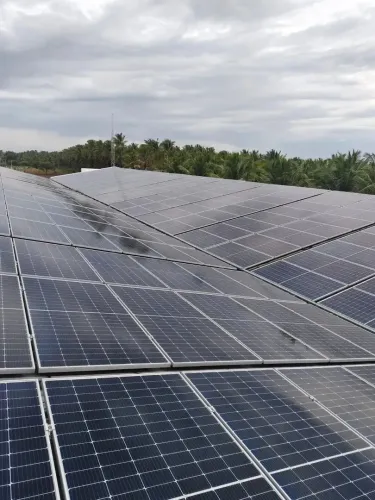
A dirty or shaded collector usually reduces daily heat gradually; it rarely causes an abrupt zero-hot-water failure. Wash off dust, bird droppings, and industrial deposits, then check for new shading from tanks, buildings, or vegetation. A damaged selective coating also lowers yield without stopping flow.
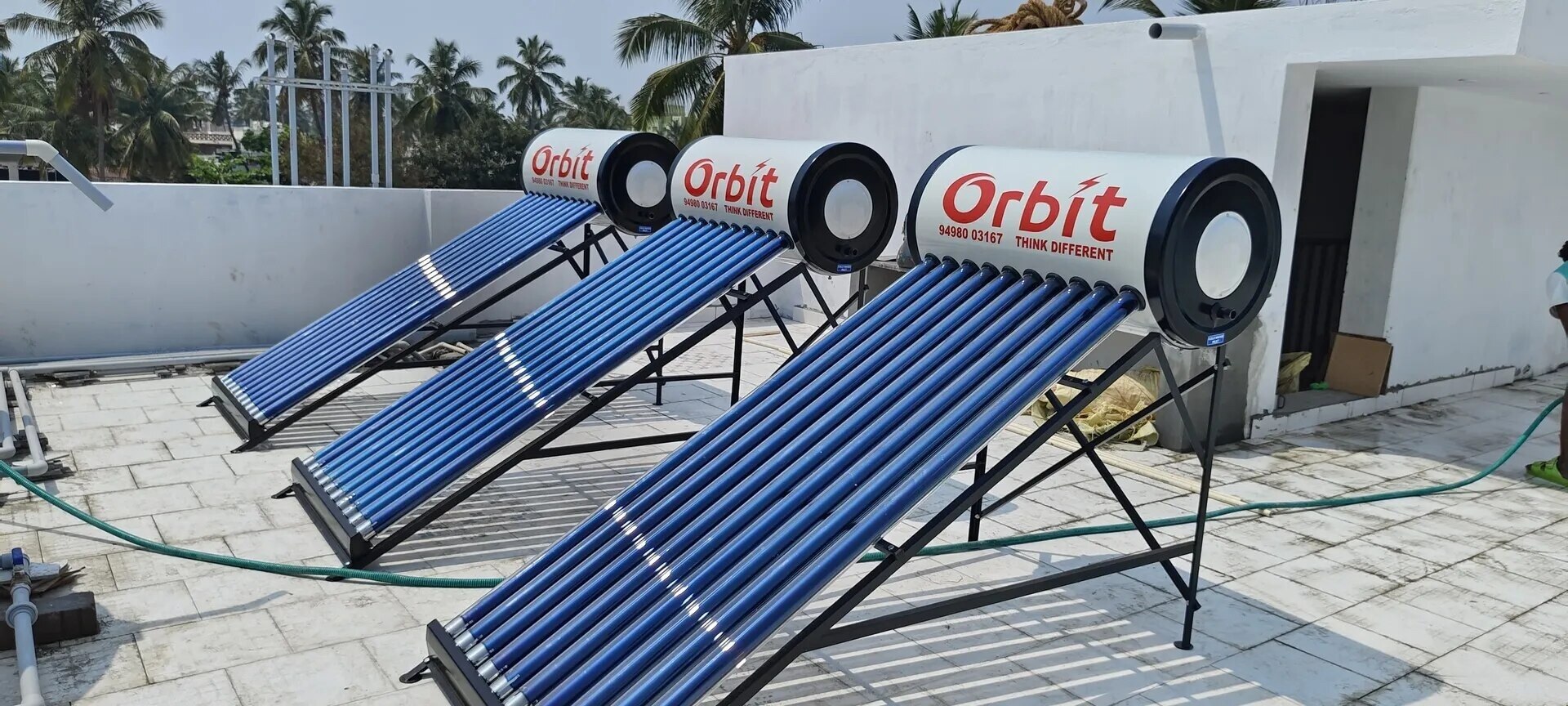
Inspect evacuated tubes for cracks, clouding, broken heat pipes, or a failed absorber seal. On flat-plate collectors, look for cracked glazing, delaminated insulation, corroded absorber plates, loose headers, and fluid stains around joints. A leaking collector loop loses pressure and can admit air, stopping circulation even when the pump runs.
Treat industrial solar heater problems as physical faults before replacing a working controller.
Water quality can destroy heat transfer on either side of a heat exchanger. Hard-water scale coats absorber passages, narrows plate-heat-exchanger channels, blocks strainers, and makes thermostatic mixing valves stick. Corrosion debris and sludge restrict flow; degraded glycol becomes acidic or thick and damages seals.
Check both circuits, because a clean solar loop does not prove that the potable-water side is clean.
| Fault | What you observe | What it means |
|---|---|---|
| Soiling or shading | Gradual lower output | Clean the collector and remove the obstruction |
| Broken tube or plate leak | Pressure loss or wet staining | Isolate and replace the damaged collector component |
| Hard-water scale | Rising temperature difference with weak flow | Descale the affected circuit or heat exchanger |
| Glycol degradation | Dark, thick, acidic fluid | Flush and refill with the specified heat-transfer fluid |
Check flow, pumps, valves, air, pressure, and controls safely
A pump that hums is not proof of circulation. A safe approach to solar water heater troubleshooting for factories starts with external observations and stops before anyone opens hot, pressurised equipment.
1. Check the controller display, alarm history, collector and tank temperatures, pump status, and time of day. A hot collector with a cool tank points to circulation; both remaining cool points toward low solar input or a sensor fault.
2. Read the flow meter without removing covers. Confirm that isolation valves are open, strainers show no blockage, check valves are not stuck, and the pump arrow matches the pipe-flow direction. Do not rely on electrical current: a running pump can be air-bound, vapor-bound, incorrectly rotated, or unable to produce enough differential pressure.
3. Compare loop pressure when cold and after heating. Pressure that falls cold, rises sharply hot, discharges through the relief valve, or repeatedly needs filling indicates an expansion-vessel or leak problem. Do not keep adding fluid; have a qualified technician test vessel precharge and leaks.
4. Have the technician purge air from the designed fill-and-drain points, then verify flow on the meter. Check that automatic air vents are open, uncapped, and not leaking. Trapped air at headers, high points, or a heat exchanger can stop circulation.
5. Test sensors, pump relays, time schedules, high-limit trips, flow and level interlocks, contactors, and the auxiliary-heater enable setting. A controller configured to block backup heat can leave the factory without hot water even when the solar loop works. Stop and isolate the system if a leak, steam, abnormal noise, or relief discharge appears.
Separate tank, heat exchanger, mixing valve, backup heater, and pipe faults
A hot solar-storage tank does not prove hot water can reach factory outlets. During a controlled draw, measure the tank top and bottom, heat-exchanger inlet and outlet, mixing-valve outlet, and recirculation return; a misplaced sensor or stratified tank can make one hot reading misleading.
- Storage tank: If the tank outlet is hot but the heat-exchanger inlet is cold, check the outlet connection, isolation valve, and internal dip tube. If only the upper sensor is hot, the tank may have insufficient usable volume.
- Heat exchanger: A hot primary-side inlet with a cold secondary-side outlet points to scale, a blocked strainer, low potable flow, or fouled plates. Hard-water deposits can restrict the potable side while the solar loop remains clean.
- Mixing valve: Compare temperatures before and after the valve. A cartridge stuck toward cold, blocked hot inlet, incorrect setting, or debris can hold outlet water below its setpoint.
- Backup heater: Confirm its power, thermostat setting, high-limit status, and enable signal. A failed element or disabled controller leaves the system cold when solar heat is unavailable.
- Pipes and recirculation: A closed valve, leaking joint, uninsulated run, air pocket, or failed return pump can cause heat loss or long waits at distant taps.
Do not open hot, pressurised equipment to prove a fault. Isolate and cool it first, then have industrial hot water system repair personnel verify flow, pressure, and temperatures at each boundary.
Choose repair, recommissioning, or replacement without hiding a hygiene risk
Repair the existing system when one component has failed and the design still meets demand: a seized pump, failed sensor, leaking valve, broken tube, or worn mixing valve does not justify replacing collectors. Industrial hot water system repair must include a leak check, flow confirmation, temperature verification, and safe pressure testing.
| Option | What it means | When it applies |
|---|---|---|
| Repair | Replace the failed part and verify operation | The storage volume, collector area, pipework, and backup heater match demand |
| Recommission | Restore circulation, controls, and safe settings | Air remains in the loop, flow is unconfirmed, valves are mis-set, or repeated relief discharge follows pump shutdown |
| EPC investigation | Review the whole hydraulic and control arrangement | Solar storage is hot but outlets stay cold, recirculation returns cold, or several components fail together |
| Redesign or replacement | Change capacity, layout, or operating strategy | Demand exceeds the original design, shading has changed, heat losses are excessive, or the backup system carries the load every day |
Do not lower storage or distribution temperatures to disguise weak solar yield. Use the site’s code and hygiene plan; UK guidance commonly uses storage of at least 60°C and outlets capable of reaching 50°C within a defined time. A specialist such as Orbit Solar India Pvt Ltd should document pasteurisation or anti-Legionella controls before recommissioning.
Repeated relief discharge, glycol boiling, or collector stagnation signals a control or hydraulic fault, not normal operation. Industrial solar heater problems that return after cleaning or part replacement warrant a design review.
Related product
 | Industrial Solar Water Heater Industrial solar water heaters are high-capacity thermal systems (1,000 to >100,000 LPD) designed for large-scale operations like manufacturing,... View product → |
Frequently asked questions
What should you measure first when an industrial solar water heater stops producing hot water?
At 1:30 p.m. during strong sun, record the complaint, collector-loop flow and return temperatures, storage-tank temperature, and outlet temperature before changing any setting. A cold tap does not prove that the collectors are failing.
Which collector and water-quality faults reduce solar hot-water production?
Inspect collectors, evacuated tubes, absorber plates, seals, insulation, and visible leaks. Check for scale, sludge, corrosion, blocked passages, and poor water quality because these faults restrict heat transfer and flow.
How do you check flow and controls safely on an industrial solar hot-water system?
Use the system’s isolation points and manufacturer procedures before opening equipment. Check pump operation, valve position, air in the loop, pressure, flow indication, sensors, controller settings, and fault codes without bypassing safety devices.
How can you tell whether the tank or backup system is causing cold water?
Compare temperatures at the tank, heat exchanger, mixing-valve inlet and outlet, backup-heater inlet and outlet, and distribution pipes. This separates storage, heat-transfer, blending, backup-heating, and pipe faults.
When should you repair, recommission, or replace an industrial solar hot-water system?
Repair a defined failed component, recommission after correcting flow, air, control, or commissioning errors, and replace equipment when corrosion, repeated leaks, obsolete controls, or poor heat-transfer performance make further repairs unreliable. Address stagnant or lukewarm water as a hygiene risk first.
Keywords