A factory needs off-grid power only when grid interruptions, power-quality faults, or site constraints cost more than the equipment required to operate independently. By measuring the real load, separating essential machinery, and modelling Coimbatore’s low-solar periods, you can decide whether to install a full microgrid, a hybrid system, a separate backup system, or no solar backup at all.
Key takeaways
- Use 12 months of outage and restart-cost records before approving off-grid power.
- Separate essential controls, safety systems, and production loads by operating priority.
- Size batteries for usable energy, peak power, autonomy, temperature, and end-of-life capacity.
- Demand site-specific designs covering heat, dust, shade, drainage, and equipment access.
When is a fully off-grid system justified for a Coimbatore factory?
A fully off-grid system is justified only when independence from the grid is worth more than the equipment needed to achieve it. Start with 12 months of outage records, including date, duration, affected production line, restart time, rejected material, labour cost, and lost contribution margin.
Add voltage dips, frequency disturbances, nuisance trips, transformer failures, and sanctioned-load limits. Then test whether grid failures threaten safety, refrigeration, process continuity, or a remote site. One short outage does not justify a solar plant sized for every machine.
Use this comparison before choosing full independence:
| Option | Best fit | Main limitation |
|---|---|---|
| On-grid rooftop PV | Reliable grid and lower electricity cost | Shuts down during a grid failure unless paired with backup |
| UPS or battery inverter | Occasional short outages affecting controls, servers, or sensitive equipment | Limited duration and motor-starting capability |
| PV-battery hybrid | Critical loads need extended backup | Requires battery replacement and low-solar planning |
| PV-battery-diesel microgrid | Frequent, long outages or continuous production | Fuel, maintenance, emissions, and generator noise |
| Fully off-grid PV-battery | No dependable grid or a site requiring independent operation | Highest storage, controls, and operating burden |
Choose solar off grid power for factories in coimbatore only when reliable independent operation costs less than the financial and operational damage caused by grid dependence. A dependable grid usually favours on-grid PV plus targeted backup.
A practical factory power backup without grid often protects controls, IT, lighting, refrigeration, pumps, and one production line while shedding non-critical machinery.
Which factory loads must the system actually support?
Support only the loads that keep people safe, protect equipment, or preserve production; do not try to run every machine by default. An off-grid solar power plant in Coimbatore must be based on measured operation, not sanctioned load or the sum of motor nameplates.
Record 15-minute interval readings for kW, kVA, power factor, voltage, current, and peak demand across every shift. Separately record starting current and the starting sequence for:
- Compressors, pumps, fans, and chillers
- Welders, CNC machines, and induction motors
Starting demand can be several times running demand. Capture each item’s running kW, starting kVA, operating hours, and allowable interruption.
Divide the schedule into three groups:
| Equipment group | Examples | Outage treatment |
|---|---|---|
| Must remain live | PLCs, control panels, servers, security, emergency lighting, refrigeration, fire pumps, instrumentation | Keep energised |
| Can restart later | Selected compressors, pumps, CNC machines, or one production line | Restart in stages |
| Must be disconnected | Non-essential machinery and comfort loads | Shed immediately |
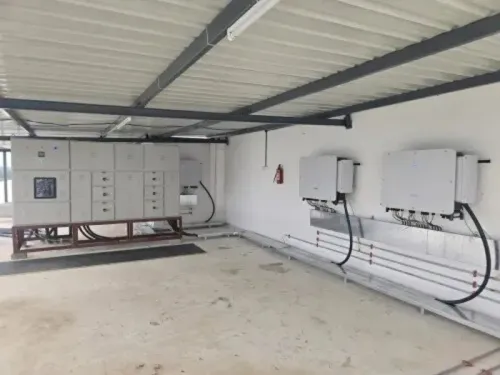
This schedule creates a practical factory power backup without grid instead of an oversized plant. A three-phase inverter must handle surge kVA, motor starting, neutral requirements, harmonics, voltage and frequency limits, earthing, and protection coordination.
VFDs, soft starters, and staged startup can reduce inverter size and prevent a compressor or motor start from tripping the entire backup system. A critical-load microgrid is often the workable boundary.
How much battery and solar capacity is needed for the required backup?
A few hours of backup and round-the-clock operation require different designs. A solar off-grid system for factories must be sized from the critical-load schedule, not the factory’s total connected load.
1. Calculate critical-load energy by multiplying each essential load’s running kW by its operating hours during the outage, then adding the results. Include controls, servers, lighting, refrigeration, pumps, and selected production equipment that must remain live.
2. Calculate nominal battery energy with this formula: required AC load energy × autonomy hours ÷ (usable depth of discharge × battery and inverter efficiency). Apply temperature derating and an ageing allowance so the battery still meets the requirement at end of service life.
3. Check battery power in kW as well as stored energy in kWh. A battery can hold enough energy yet fail to start a compressor when the inverter lacks the required surge kVA. Stage motor starts, or use a soft starter or VFD where appropriate.
4. Model hourly PV production against hourly load for sunny, cloudy, and monsoon-period days. Shift pumps, compressors, refrigeration, and process heating into daylight where production allows. Several cloudy days without grid supply require far more PV and battery capacity than a few hours of industrial solar backup power in Coimbatore.
5. Compare solar-only storage with PV-battery-diesel or PV-battery-biomass backup. These options provide firm supply with less battery capacity. A grid-tied inverter alone cannot provide backup because anti-islanding protection shuts it down during a utility failure.
What Coimbatore site conditions can make or break the design?
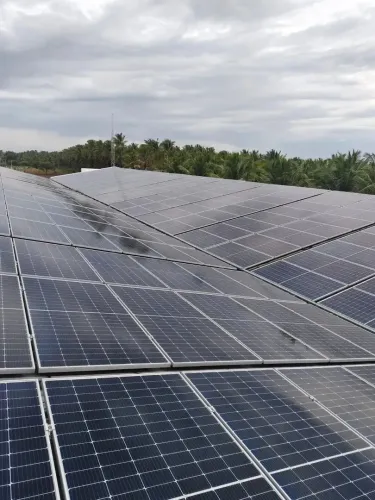
A site can make a solar off grid system for factories unsafe or unreliable, even when annual solar averages look favourable. Model hourly solar production and load through monsoon and cloudy intervals; inspect shading from tanks, parapets, trees, exhaust stacks, and neighbouring buildings.
Add cleaning access, drainage, and cable routes that preserve maintenance and fire access.
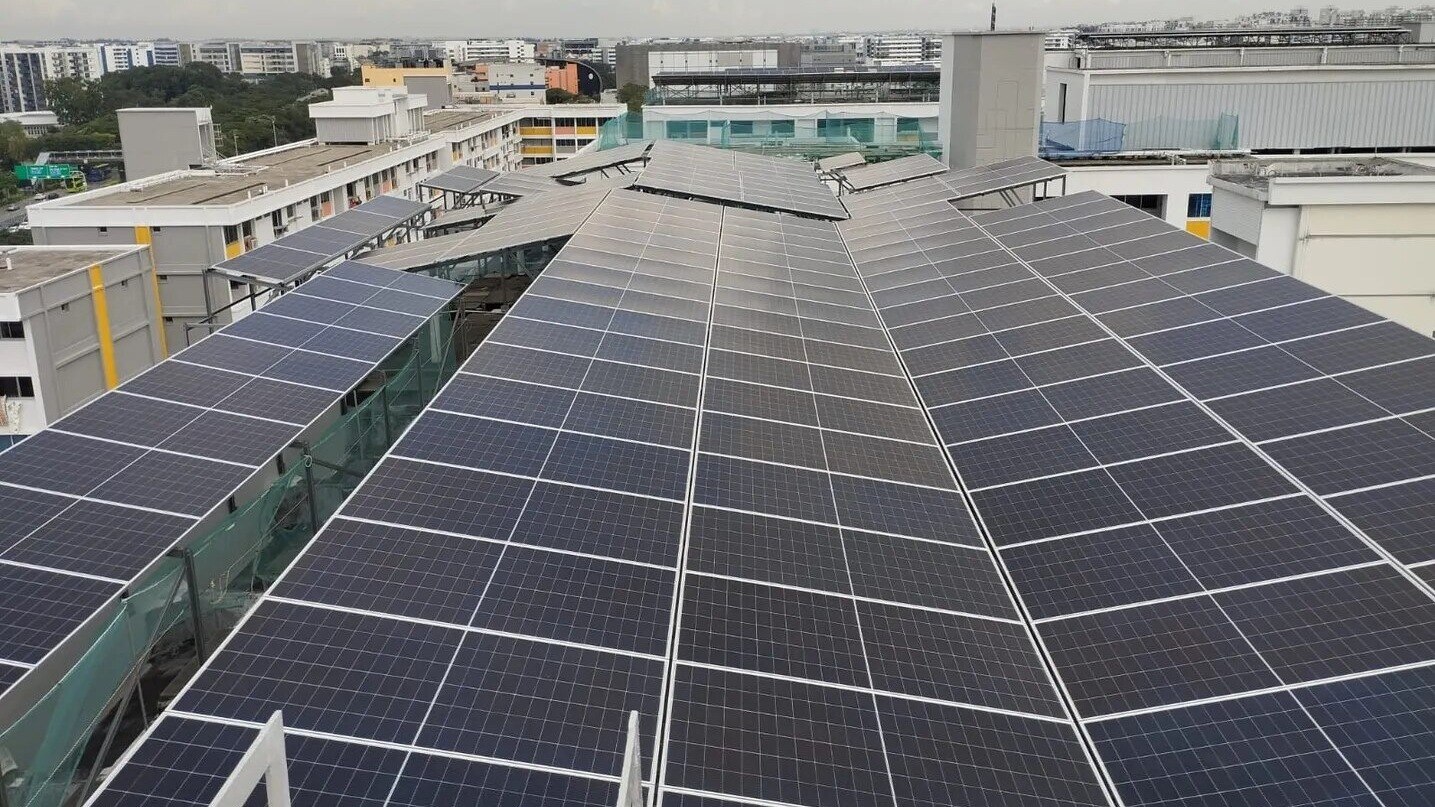
1. For a metal-sheet roof, verify sheet thickness, purlins, corrosion, fasteners, waterproofing, wind loads, and the added load and obstruction from walkways and cable trays. For RCC, inspect slab condition, cracks, waterproofing, anchor locations, ballast loads, and structural capacity. Obtain a structural assessment before fixing panels.
2. Inspect the battery room for heat, ventilation, fire separation, emergency isolation, replacement access, and maximum internal temperature. Coimbatore heat accelerates battery ageing. Specify thermal monitoring, HVAC or ventilation, protective enclosures, and a fire-response plan: lithium needs battery-management and thermal-runaway protection; lead-acid needs ventilation and loses capacity faster under repeated deep discharge.
3. Specify three-phase voltage and frequency limits, harmonic performance, neutral and earthing arrangements, lightning protection, DC isolators, surge protection, short-circuit withstand, protection coordination, and the islanding point. Confirm compatibility with PLCs, CNCs, instrumentation, and variable-speed drives—not only PV kWp and battery kWh.
How should you compare the final options and supplier proposals?
Approve the proposal with the lowest delivered cost per usable kWh after adding outage cost, not the proposal with the cheapest modules.
| Option | Strength | Main risk |
|---|---|---|
| Grid-connected PV plus UPS | Lowest storage burden | Does not run large loads during long outages |
| Hybrid PV-battery-diesel | Handles cloudy periods and high demand | Fuel and maintenance costs continue |
| Critical-load microgrid | Supports essential operations efficiently | Non-critical machinery is shed |
| Fully off-grid PV-battery | Maximum independence | Largest battery, PV, and low-solar risk |
Compare battery replacement or augmentation, inverter replacement, generator fuel and servicing, HVAC, fire protection, civil works, structural repairs, cleaning, scheduled downtime, financing, and lost production during maintenance. Include the cost of rejected material, restart labour, and idle production when calculating outage cost.
Give every supplier identical data and request:
- Load profile used, critical-load list, autonomy definition, minimum state of charge, cloudy-day simulation, battery end-of-life capacity, inverter surge rating, motor-starting method, and generator-start logic.
- A single-line diagram showing PV strings, DC protection, battery inverter, AC switchgear, automatic transfer or islanding device, utility separation point, earthing, and backup circuits.
For factory power backup without grid, the practical design is often a critical-load microgrid supporting controls, IT, lighting, refrigeration, pumps, and selected production while shedding non-critical machinery. Compare Orbit Solar India Pvt Ltd with at least two proposals using the same assumptions.
Approve full independence only when low-solar modelling beats hybrid, UPS, diesel, or grid-connected PV alternatives for your industrial solar backup power in Coimbatore.
Related products
 | Solar Off Grid Power Plant Off-grid solar power plants are independent, battery-based systems that generate, store, and supply electricity without relying on the utility grid. View product → |
 | Industrial Rooftop Solar Power Plant Industrial Rooftop Solar Power Plant (RCC ROOF SHEETS ROOFTOP) Industrial rooftop solar plants, installed on factory and warehouse RCC or metal sheet roofs, convert sunlight into electricity, significantly... View product → |
Frequently asked questions
When is a fully off-grid system justified for a Coimbatore factory?
It is justified when the documented cost of outages, restarts, rejected material, labour, and lost contribution margin exceeds the cost and operating burden of grid-independent equipment.
Which factory loads must an off-grid system support?
List loads by priority, starting with safety systems, controls, communications, lighting, refrigeration, process equipment, and other loads that must run during an outage. Record each load’s running power, starting surge, operating schedule, and restart requirements.
How much battery and solar capacity does a factory need for backup?
Calculate battery capacity from required backup hours, usable depth of discharge, inverter losses, temperature, and end-of-life capacity. Size solar generation for daily energy demand, seasonal irradiation, charging losses, and the required recovery after cloudy periods.
What should you compare in supplier proposals?
Compare the same load schedule, autonomy target, peak and starting power, battery warranty terms, replacement assumptions, monitoring, maintenance response, safety provisions, site work, exclusions, and total cost of ownership.
Related products
 | Hybrid Solar Power Plant A hybrid solar power plant combines solar panels, battery storage, and grid connectivity to provide reliable, 24/7 electricity. View product → |
 | On Grid Solar Power Plant An On-Grid (or grid-tied) solar power plant is a system that works directly with the utility grid, allowing users to power their homes with solar... View product → |
 | Commercial Rooftop Solar Power Plant Commercial Rooftop Solar Power Plant Commercial rooftop solar power plants are large-scale photovoltaic (PV) systems installed on commercial, industrial, or institutional buildings to... View product → |
 | Ground Mounting Solar Power Plant Ground Mounting Solar Power Plant Ground-mounted solar power plants are photovoltaic systems installed on the ground rather than rooftops, typically using metal frames, concrete, or... View product → |
Keywords