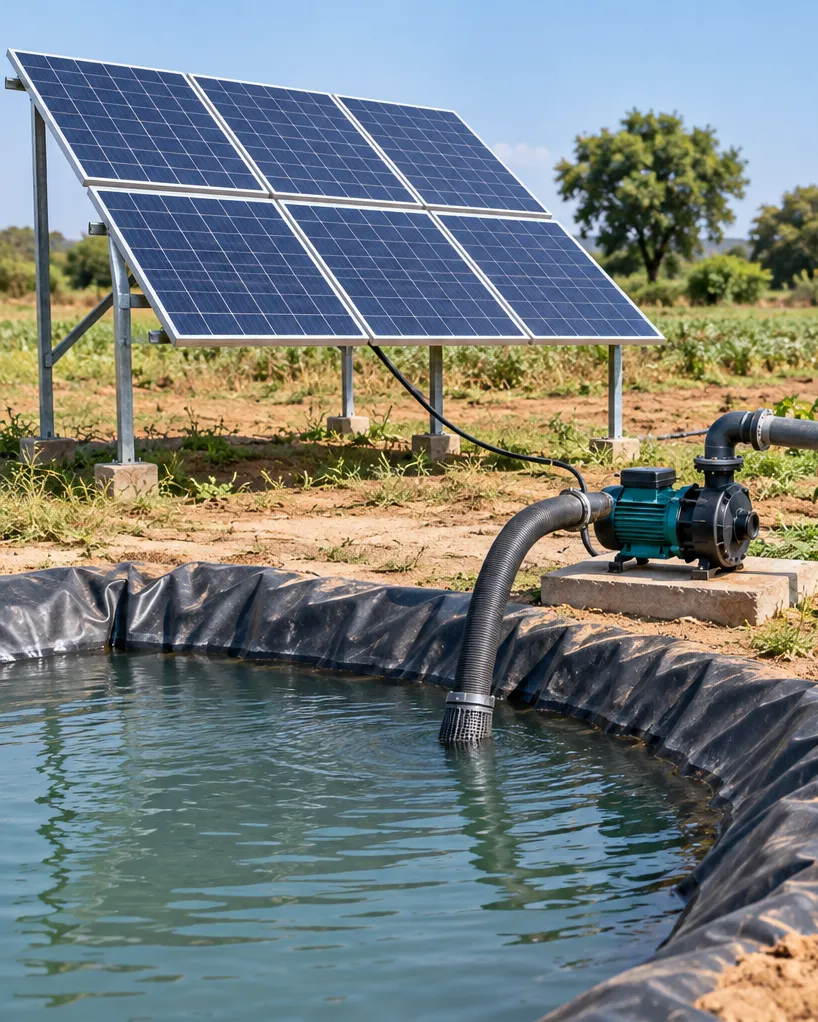
Reliable water pumping is fundamental to agricultural operations. Farmers may need water for irrigation, livestock, storage tanks, or movement between water sources, and conventional pumping can depend heavily on grid availability or other energy inputs.
A solar agriculture pump converts available solar energy into electricity for pumping, making it an option worth evaluating for agricultural land in Karur and other farming regions of Tamil Nadu.
Choosing the right system, however, requires much more than matching a pump's horsepower rating.
Start With the Water Requirement
The most useful starting point is determining how much water is required each day.
This depends on factors such as:
- Crop type
- Cultivated area
- Irrigation method
- Season
- Soil conditions
- Water source
- Irrigation schedule
A farm using drip irrigation may have a different pumping requirement from one using another irrigation method across a similar area.
Identify the Water Source
The source strongly influences pump selection.
Water may come from a borewell, open well, pond, canal-linked storage arrangement, or another source.
Important measurements include water level and the vertical and horizontal distance through which water must be moved.
These values contribute to the total pumping head.
Selecting a pump without understanding head requirements can result in poor water delivery even if the motor rating appears adequate.
Do Not Choose by Horsepower Alone
Horsepower is easy to compare, which is why buyers often use it as the main selection criterion.
It is not enough.
Pump performance also depends on flow rate, total dynamic head, pump type, system efficiency, pipe dimensions, and operating conditions.
A correctly engineered lower-rated system may sometimes be more appropriate for a specific requirement than a larger pump selected without hydraulic calculations.
Check the Solar Array Requirement
The photovoltaic array needs to provide appropriate energy for the pumping system.
Array capacity and configuration should correspond with the pump, controller, operating conditions, and expected solar availability.
The installation area should have good solar exposure with minimal shading.
On agricultural land, panel structures should also be positioned to reduce interference with routine farming activity.
Think About Water Storage
In some agricultural applications, storing pumped water can be more practical than storing electricity in batteries.
Solar energy can be used to pump water during suitable daylight periods into an elevated or ground-level storage facility, depending on the irrigation design.
Stored water can then support irrigation according to the farm's required schedule.
Whether this approach is suitable depends on the individual farm and water-management system.
Evaluate Controls and Protection
A solar pumping system includes more than panels and a motor.
Depending on the configuration, controllers and protection systems can help manage pump operation under changing solar conditions and protect equipment against unsuitable operating situations.
Ask the provider to explain what protections are included and how the farmer will operate or monitor the system.
Assess the Site Before Buying
For agricultural projects around Karur, a site assessment should capture borewell or source details, water requirement, pumping head, irrigation method, available installation space, shading, and future farming plans.
Orbit Solar India Pvt Ltd provides solar pumping and other renewable energy solutions for agricultural applications.
Farmers and agricultural procurement teams should expect a provider to ask detailed questions before recommending capacity. A quotation prepared without knowing the water source, pumping head, required flow, or irrigation pattern may not provide enough information for a reliable decision.
The right solar pump is ultimately the one designed around the farm's water requirement. Hydraulic performance, solar capacity, controller selection, installation conditions, serviceability, and water-management strategy should all work together as one system.
Keywords