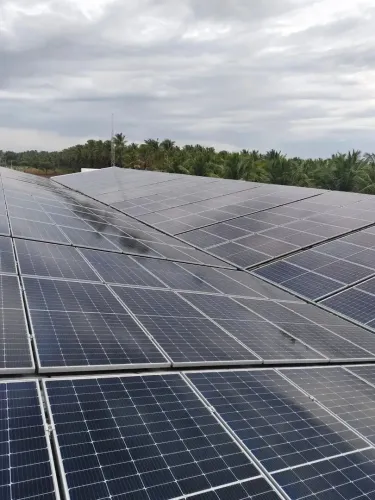
Installing solar at a commercial property is a capital decision that should be evaluated with the same discipline as other business infrastructure. A quotation showing panel capacity and total price is useful, but it does not reveal whether the proposed commercial solar power plant is appropriately designed for the property.
For business owners and procurement teams in Erode, Tamil Nadu, comparing proposals becomes easier when technical suitability, projected generation, warranties, maintenance, and financial assumptions are reviewed together.
Begin With the Business Load Profile
A commercial solar proposal should reflect when and how electricity is consumed.
Offices, showrooms, hospitals, educational institutions, hotels, warehouses, and retail facilities can have very different load patterns.
Businesses with substantial daytime consumption may be able to use a meaningful portion of solar generation directly while the system is producing electricity.
Before evaluating capacity, review:
- Monthly electricity consumption
- Daytime electricity demand
- Operating days and hours
- Seasonal fluctuations
- Large individual loads
- Planned business expansion
This provides a better foundation than selecting a system purely by available roof area.
Compare Expected Generation Assumptions
Two proposals with identical installed capacities may show different projected annual generation.
Ask why.
Generation estimates can be influenced by module orientation, tilt, shading, equipment efficiency, system losses, local solar conditions, and modelling assumptions.
A credible proposal should make the important assumptions understandable rather than presenting projected generation as a guaranteed number.
Compare Equipment Specifications Properly
Solar modules frequently receive most of the attention, but the inverter, mounting structure, electrical protection equipment, cables, monitoring system, and other components also matter.
Compare specifications in equivalent categories.
A lower-cost proposal using a materially different equipment configuration cannot be evaluated fairly against another quotation solely through the final project price.
Examine the Roof and Mounting Design
Commercial roofs in Erode may differ considerably in construction and condition.
Before installation, evaluate:
- Usable roof area
- Roof structure
- Existing equipment
- Shading
- Drainage
- Maintenance pathways
- Mounting approach
- Wind considerations
- Waterproofing implications
The module layout should allow the building to continue functioning normally.
Calculate Financial Returns With Realistic Inputs
Solar financial evaluations may include projected electricity savings, simple payback, internal rate of return, or other measures.
Whatever method is used, examine the assumptions behind it.
Important inputs can include expected solar generation, current applicable electricity costs, self-consumption, operating expenses, maintenance, equipment degradation, and any assumptions about future tariffs.
Avoid treating an attractive payback figure as meaningful unless its calculation can be understood.
Review Warranties Separately
'Solar warranty' is not a single warranty.
There may be different warranty conditions for modules, inverters, workmanship, structures, and other equipment.
Module product warranties and performance warranties can also represent different commitments.
Procurement teams should obtain clarity on what is covered, for how long, and which party handles warranty support.
Ask About Monitoring and Maintenance
A commercial system needs ongoing visibility.
Determine how generation will be monitored, who reviews faults, what routine inspection is recommended, how module cleaning should be managed, and what happens when equipment requires service.
Orbit Solar India Pvt Ltd works with solar power solutions across different customer categories, including commercial applications. Businesses in Erode can use a site and load assessment to establish whether proposed system capacity and design correspond with actual operating requirements.
The strongest commercial solar proposal is not necessarily the one with the highest capacity or lowest upfront price. It is the one whose engineering assumptions, equipment, expected performance, financial projections, warranties, and after-installation requirements make sense when examined as a complete project.
Keywords