

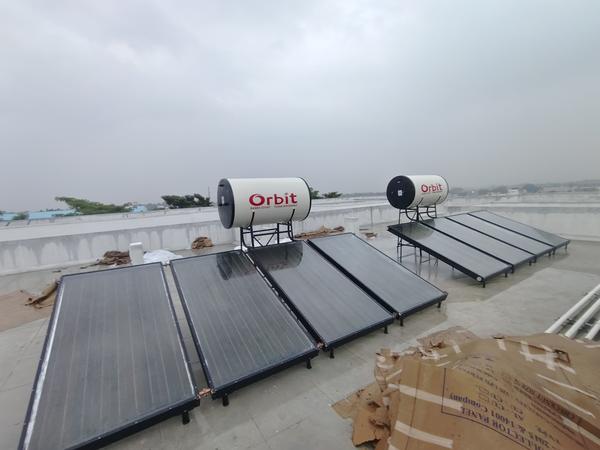
Industrial solar water heaters are high-capacity thermal systems (1,000 to >100,000 LPD) designed for large-scale operations like manufacturing, hotels, and hospitals. They utilize evacuated tube collectors (ETC) or flat plate collectors (FPC) to convert solar radiation into heat for water up to 60 C to 80 C Key Components and Features: Capacity: Range from 1,000 LPD (Litres Per Day) to over 100,000 LPD to meet high demand. Collectors: Typically uses ETC for better efficiency in various weather conditions, or FPC for specific applications. Storage Tanks: Insulated stainless steel tanks, often with food-grade SS inner tanks. Controller: Digital controllers with sensors often manage the system, using pumps to circulate water when temperature differentials exceed set limits. Working Principles: Thermosyphon System: Natural circulation where heated water rises to the top of the tank, and colder water sinks. Forced Flow System: Utilizes pumps to move water between collectors and the storage tank. Hybridization: These systems often integrate with existing industrial boilers or heat pumps to ensure a constant supply, acting as a preheating solution. Benefits: Cost Efficiency: Drastically reduces electricity bills, potentially replacing conventional heaters for substantial savings. Sustainability: Reduces carbon footprints with zero emissions. Durability: Systems often have low maintenance, high-efficiency ratings, and, according to, can operate for over 340 days a year. नवीन और नवीकरणीय ऊर्जा मंत्रालय नवीन और नवीकरणीय ऊर्जा मंत्रालय Common Applications: Industrial process heating (dyeing, chemical treatment, pasteurization). Boiler feed water preheating. Large-scale commercial use (hospitality, hostels).
Address
100/112, Poompuhar Nagar, Kattabomman Street, Ganapathy, Coimbatore, Tamil Nadu 641006
Coimbatore, India, 641006