A Coimbatore institution cannot compare solar hot-water systems by tank size or collector count alone: a 5,000 LPD quotation can describe very different usable output, backup energy and installed cost. The comparison below gives budgetary price bands, a common quotation checklist and the operating data you need before selecting a system.
Key takeaways
- Compare capacity and installation basis, not only the quoted rupee total.
- Request separate prices for collectors, tanks, pumps, structure, controls and commissioning.
- Size the system from measured hot-water demand and peak-use timing.
- Keep backup heating for cloudy periods, peaks and process-critical hot water.
What budget should you set for 1,000 to 100,000 LPD?
A practical industrial solar water heater price for comparison in coimbatore starts with the daily capacity, but the installation basis matters just as much. The bands below are budgetary for 2026 and intended for first-pass screening, not tender acceptance.
| Capacity | Budgetary 2026 band | Price basis |
|---|---|---|
| 1,000 LPD | ₹1.5–4 lakh | Ex-site Coimbatore; before GST, freight, difficult roof access and civil work |
| 5,000 LPD | ₹6–15 lakh | Ex-site Coimbatore; before major site modifications and GST |
| 10,000 LPD | ₹12–30 lakh | Ex-site Coimbatore; before major piping, structural work and GST |
| 25,000 LPD | ₹30–75 lakh | Ex-site Coimbatore scaled screening estimate; not a market quotation |
| 100,000 LPD | ₹1.2–3 crore | Ex-site Coimbatore scaled screening estimate; not a market quotation |
1. Treat ETC equipment as the lower-end option for many institutional applications. Larger flat-plate or pressurised systems cost more because collectors, supports, controls and protection requirements increase.
2. Do not treat the industrial solar water heater cost in coimbatore as comparable until the quote states whether it is ex-works, ex-site Coimbatore or turnkey installed.
3. Request a site-specific RFQ above pilot scale. Storage volume, heat exchangers, long pipe runs, structural reinforcement, crane access and backup integration can move the turnkey installed price sharply beyond these bands.
4. Ask for separate pricing for solar equipment, civil and structural work, distribution piping, electrical controls, backup heating, testing, commissioning, GST and annual maintenance.
How to compare two commercial solar water heater quotations line by line
A commercial solar water heater quotation is not comparable if one bidder gives a turnkey total and another prices only collectors and tanks. Ask both suppliers to use the same schedule of quantities, with every entry below priced separately.
| Category | Equipment | Site works | Operating integration |
|---|---|---|---|
| Core hardware | Collectors; storage tank; heat exchanger; pumps; valves; pressure-relief devices; non-return valves; air vents; expansion accommodation | Support structure; roof mounting; ground mounting; roof reinforcement; foundations; crane access | Controls; insulation; interconnecting piping; hot-water circulation loop; thermostatic mixing valve; electrical panel |
| Distribution and services | Replacement fittings and instrumentation | Long distribution piping; water-treatment equipment; transport; erection | Electrical work; connection to an existing boiler or heat-pump loop |
| Completion and support | — | Testing; commissioning; GST | Annual maintenance; backup-heater connection and controls |
Do not accept “included” without a quantity, specification and price. Require pipe length and diameter, tank material and volume, collector area, pump duty, insulation thickness and electrical-panel scope.
Ask each bidder to state the price basis—ex-works, ex-site Coimbatore or turnkey installed—and list warranty exclusions, replacement-tube or absorber prices, response time and annual maintenance visits. The lowest institutional solar water heating price is often only a hardware price.
Recalculate the total after adding omitted civil work, piping, electrical work and backup integration; only then does the industrial comparison become valid.
How much hot water does your institution actually need?
1. Build the design load from activity, not from a supplier’s nominal LPD figure. Count beds and daily occupants, meal servings, kitchen shifts, laundry loads, bathing schedules, staff facilities and process uses such as cleaning or production.
2. Record litres per person per day for each use. For laundry, record litres per load; for kitchens, litres per meal serving; for process work, record litres per batch. Add the categories to obtain total daily demand, then map draw-off times separately so morning peak demand is not hidden inside the daily total.
3. Check the heat load before requesting an institutional solar water heating price. Heating 1,000 litres from 25°C to 60°C requires about 40.7 kWh of useful thermal energy before collector, piping, tank and control losses. The array must supply more than that figure.
4. Treat LPD as expected daily production under stated test conditions, not storage-tank volume or guaranteed delivery. Two 1,000 LPD systems can provide different usable results.
5. Require every quotation to state inlet and outlet temperatures, solar-radiation assumption, storage volume, solar fraction, backup-heater capacity and minimum daily delivery at the specified temperature. Also request maximum operating pressure, shading assumptions and commissioning measurements.
6. Use 20–30 m² of collector area per 1,000 LPD only as a preliminary Coimbatore reference. ETC or flat-plate selection, temperature, orientation and shading change the result, so require monthly load and solar-resource modelling before procurement.
Which collector and operating specification fits Coimbatore?
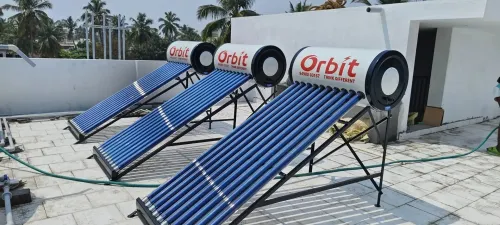
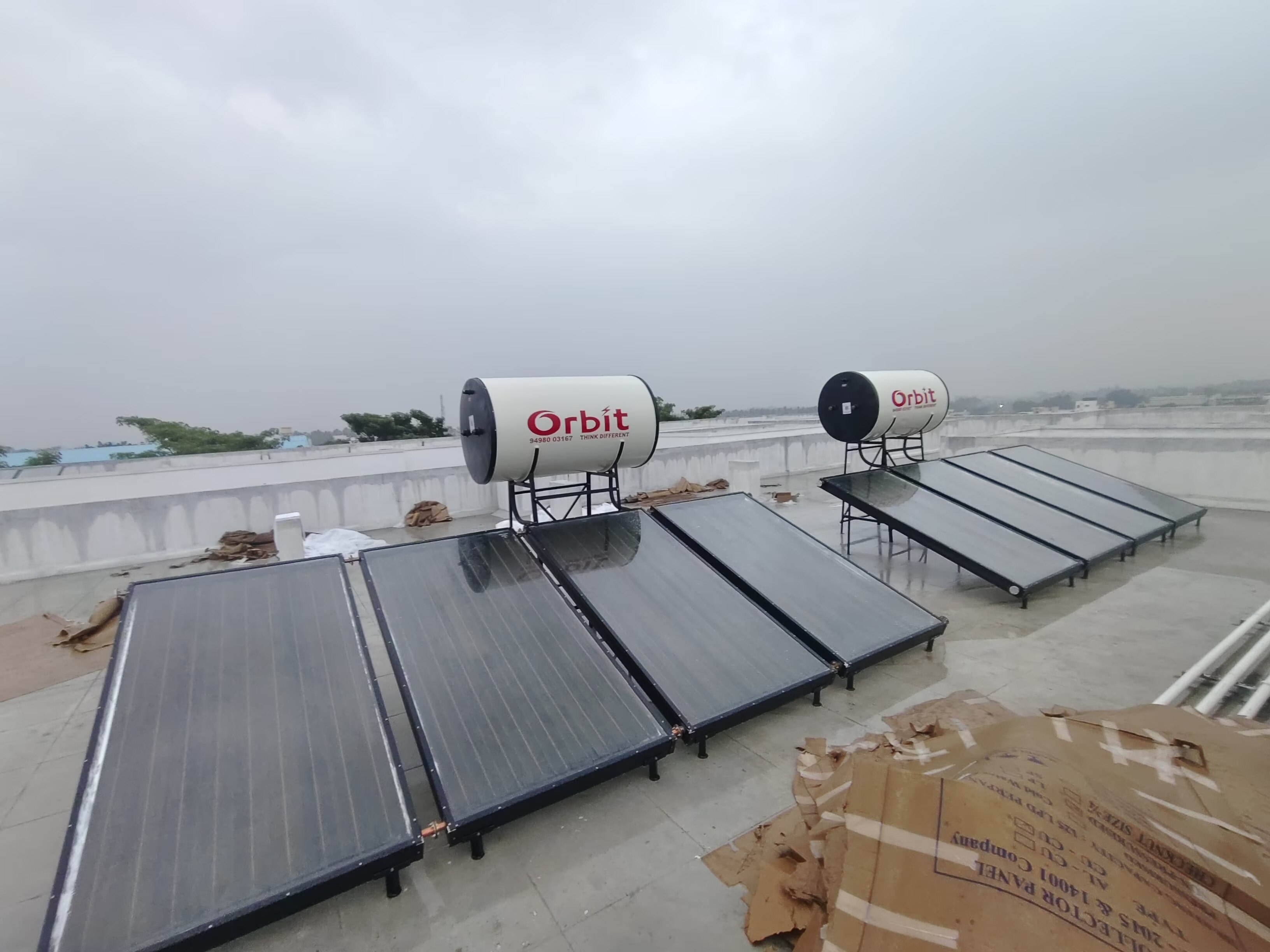
ETC usually lowers the initial cost for low- and medium-temperature institutional hot water. Its lifecycle cost rises when broken tubes, lost vacuum or difficult roof access delay repairs; FPC costs more upfront but has a more robust absorber assembly.
| Option | ETC | FPC |
|---|---|---|
| Cloudy-weather performance | Compare measured output at the required temperature rise under low irradiance | Compare the same test basis; do not accept area-only claims |
| Low draw-off | Require stagnation protection, heat dumping or controller isolation | Require the same overheating protection for idle periods |
| Impact exposure | Glass tubes are vulnerable to hail, vandalism and accidental impact | Robust absorber assembly suits exposed sites better |
| Cleaning access | Check tube replacement and washing access | Check absorber and glazing access |
| Spare parts | Confirm tube, seal and manifold prices and local stock | Confirm absorber, glazing and seal availability |
| Annual maintenance | Budget tube inspection, vacuum-loss replacement and cleaning | Budget cleaning, leak checks, insulation checks and control servicing |
Ask for a design basis stating target delivery temperature, storage temperature, morning peak, maximum operating pressure, water hardness, filtration or softening, recirculation temperature and pipe insulation thickness. “1,000 LPD” alone is not a delivery guarantee.
Hard borewell water can scale heat exchangers, risers and electric backup heaters. Require these documents:
- Water analysis, descaling frequency and anode-replacement schedule
- Collector orientation, shading assumptions and stagnation-protection method
- Commissioning measurement method, including temperatures, flow and delivered litres at the specified temperature
When should solar work with, rather than replace, backup heating?
A solar-plus-backup system suits an institution with daytime collection, predictable demand and hot water needed after sunrise. Keep electric heaters or a boiler for early-morning peaks, cloudy days, monsoon periods and hygiene-temperature control; do not size solar to the rare maximum draw-off.
| Option | Capital cost | Backup energy and response | Connection, reliability and maintenance |
|---|---|---|---|
| Solar thermal only | Lowest operating equipment scope | No dependable pre-dawn or cloudy-day supply | No backup connection, but service interruption is serious |
| Electric geysers | Lower initial complexity | Electricity; rapid response for small peaks | Needs adequate sanctioned load; inspect elements, thermostats and scale |
| Heat-pump water heater | Higher than basic electric heating | Electricity; slower recovery, lower consumption per unit of heat | Needs electrical capacity, airflow and refrigerant service |
| Gas or biomass boiler | Boiler, fuel system and safety work add cost | Gas or biomass; fast recovery when fuel is available | Requires fuel logistics, combustion checks, flue maintenance and operator attention |
| Boiler-plus-solar | Highest integration scope | Solar reduces boiler runtime; boiler covers peaks | Most reliable when controls, storage, pumps and changeover logic are commissioned together |
A 1,000 LPD load heated from 25°C to 60°C represents about 14,850 kWh of useful annual heat before losses. Displaced electricity depends on occupancy, backup operation and tariff, so a universal payback claim is misleading.
Give solar hot water system suppliers in Coimbatore one design schedule, then compare installed cost per LPD, collector area, guaranteed delivery temperature, backup consumption, exclusions, spares and local response time. Orbit Solar India Pvt Ltd can be included in that like-for-like request.
Related product
 | Industrial Solar Water Heater Industrial solar water heaters are high-capacity thermal systems (1,000 to >100,000 LPD) designed for large-scale operations like manufacturing,... View product → |
Frequently asked questions
What determines an industrial solar water heater price in Coimbatore?
Daily capacity from 1,000 to 100,000 litres, collector type, storage volume, mounting structure, piping distance, controls and installation conditions determine the budget.
How should you compare two commercial solar water heater quotations?
Compare each quotation line by line, including collector area, tank material and insulation, pumps, controls, structure, piping, commissioning, warranty and exclusions.
How much hot water does an institution need?
Calculate demand from user numbers, litres per person or process cycle, inlet-water temperature, required outlet temperature and peak consumption timing.
Should solar water heating replace backup heating?
Use solar as the primary heat source and retain electric, gas or boiler backup when hot water is required during cloudy periods, demand peaks or critical operations.
Keywords